
Unicorn vs Pegasus: Who Would Win? (5 Rounds)
- , by Jessica Miller
- 13 min reading time

What's the Difference Between a Unicorn and a Pegasus?
Two of mythology's most beloved creatures. And people mix them up all the time. The unicorn and Pegasus both look like horses, sure. But that's pretty much where the similarities end.
Here's the short version: a unicorn is a horse-like creature with a single spiral horn on its forehead, known for purity and magical healing powers. Pegasus is a specific winged horse from Greek mythology, born from Medusa's blood, famous for flight and speed.
But there's so much more to it than that. We're breaking down these two legendary beings round by round: their origins, their powers, their beauty, and their cultural impact. And we'll throw in the alicorn (the winged unicorn hybrid) because honestly, that question comes up a lot too.
Unicorn vs Pegasus: Side-by-Side Comparison
Before we get into the details, here's a quick overview of how these two mythical horses stack up against each other:
- Unicorn - Horse with a single spiral horn. Origin: Ancient Indus Valley civilizations (2500-2000 BC) and Greek natural histories. Powers: healing, purification, detecting poison. Symbolism: purity, innocence, magic. Appears across global cultures.
- Pegasus - Horse with large feathered wings. Origin: Greek mythology (born from Medusa and Poseidon). Powers: flight, super speed, created the Hippocrene spring. Symbolism: freedom, inspiration, poetic arts. Primarily a single character in Greek myth.
- Alicorn - Horse with both horn AND wings. Origin: Modern fantasy and pop culture. Powers: combines unicorn magic with Pegasus flight. Symbolism: ultimate power, perfection. Most popular through My Little Pony.
Now let's dig into each round. If you're curious about more fascinating unicorn facts and mythology, we've got you covered there too.
The Difference in Origins: Who Came First?
The Unicorn's Ancient History

The unicorn goes way, way back. We're talking thousands of years before the common era.
Ancient Greek explorers who traveled to India and Persia described the unicorn as a real animal, not a myth. They called it the "Monoceros" (literally "one horn") and wrote about it in natural history texts, not fantasy stories. Ctesias, a Greek physician, described it around 400 BC as a wild donkey-like creature with a single horn that could purify poisoned water.
Curious whether any of these ancient descriptions could be based on real animals? We dug into whether unicorns were ever actually real - and the answer involves a 3.5-tonne prehistoric beast.
But here's the thing. The unicorn might be even older than Greek accounts. The Western unicorn is quite distinct from its Asian counterpart in appearance, history, and symbolic meaning. We actually broke down every definition of the word unicorn if you want the full picture - it goes way beyond mythology.
In Western tradition, the unicorn is paradoxically wild yet pure, untamable yet gentle. Medieval legends claimed only a virgin could tame one. The creature would lay its head in her lap, drawn by her innocence. That story - and dozens more from every continent - is covered in our complete unicorn mythology guide.
The Pegasus Origin Story

Pick your favorite


Among all the fantastic creatures of Greek mythology, Pegasus is one of the most recognizable. But unlike the unicorn (which is a species), Pegasus is a specific individual. There's only one.
The earliest written source is Hesiod's Theogony (9th or 8th century BC), which describes Pegasus springing from Medusa's neck when Perseus beheaded her. Because Medusa had been cursed by Poseidon, god of the sea, Pegasus was born from that divine connection.
Ovid elaborated on the birth in his Metamorphoses. Pindar told the story of how the hero Bellerophon captured Pegasus with a golden bridle given by Athena. And Hyginus recorded several episodes in his Fabulae.
Reconstructing a single coherent timeline for Pegasus is tricky, though. Different ancient writers tell contradictory versions of the story.

Verdict: Seniority
This one's close. The unicorn takes it. While Hesiod wrote about Pegasus around the 8th century BC, unicorn-like creatures were depicted on Indus Valley seals dating to 2500-2000 BC. That's over a thousand years earlier.

Indus Valley seal with unicorn animal, c. 2500-2000 BC. British Museum.
Round 1: Unicorn wins.
The Difference in Pop Culture: Unicorn vs Pegasus Popularity
The Unicorn in Modern Culture
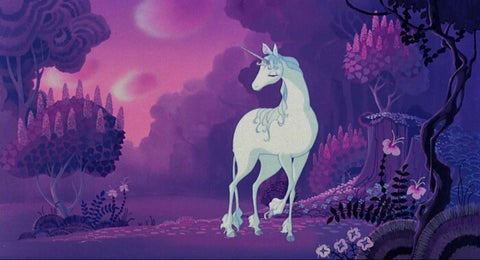
After centuries in natural history texts and medieval tapestries, the unicorn exploded into popular culture. The most famous literary unicorn is probably from Peter S. Beagle's The Last Unicorn (1968), which became an animated film and a cult classic.
Unicorns pop up everywhere in fantasy literature: C.S. Lewis's Narnia, the Harry Potter series (where unicorn blood is a powerful but cursed elixir), The Neverending Story, and Guy Gavriel Kay's The Fionavar Tapestry.
And then there's the internet era. Since the early 2000s, unicorns have become a full-blown cultural phenomenon, from startup terminology ("unicorn company" = billion-dollar valuation) to the rainbow-maned emoji we all know and love. Want proof of how deep this goes? We've collected over 200 unicorn names that fans have come up with.
Pegasus in Modern Culture

Pegasus has a strong presence too, especially in visual media. Disney's Hercules (1997) features a lovable, goofy Pegasus with a blue brush-cut mane. Though the film takes plenty of liberties with the actual Greek myths (Hercules never rode Pegasus in the original stories).
Other notable appearances:
- Saint Seiya (Knights of the Zodiac) - Seiya, the lead protagonist, is the Knight of Pegasus, wearing armor inspired by the winged horse constellation.
- My Little Pony: Friendship Is Magic - Several main characters are pegasi, including Rainbow Dash and Fluttershy.
- Marvel Comics - The Pegasus Project is a new energy research center, and characters like Valkyrie ride winged horses.
- Barbie and the Magic of Pegasus - A pink winged horse named Brietta helps Princess Annika on her quest.
Verdict: Cultural Impact
The unicorn wins this round by a horn's length. While Pegasus has memorable appearances in film and anime, the unicorn has become a genuine cultural icon, a symbol, a meme, a lifestyle. You don't see people calling themselves "Pegasus girls." You do see people rocking celebrity-inspired unicorn hairstyles, though. You do see dabbing unicorns everywhere, though.
Round 2: Unicorn wins.
The Difference in Appearance: Which Mythical Horse Is More Beautiful?
The Unicorn's Beauty
Do we even need to make the case here? The unicorn's beauty is legendary. Literally. That twisted spiral horn, the silvery-white coat, the flowing mane catching the wind. Whether depicted in realistic medieval tapestries or kawaii cartoon style, unicorns radiate something special.
And the diversity of unicorn representations is part of the appeal. From the fierce, muscular unicorn of heraldry to the cute pastel versions on kids' backpacks, from mysterious black unicorns to rainbow-maned sparkle horses, unicorns come in every flavor.
If you're into the aesthetic, our unicorn decoration collection captures that magical vibe perfectly for your space.
Pegasus's Majesty
Let's be fair. Pegasus is stunning. Those massive feathered wings give it a majestic, almost divine quality that no other mythical horse can match. There's a reason artists have been painting Pegasus for millennia.
But Pegasus has a limitation: it's almost always depicted the same way. White body, white wings, noble pose. The unicorn's visual versatility gives it an edge. It can be cute, fierce, dark, colorful, minimal, or over-the-top fabulous.
Verdict: Beauty
We'll call this one a draw. Pegasus has the raw majesty of those wings. The unicorn has range. Both are gorgeous.
Round 3: Draw.
Start your collection here


The Difference in Power: Unicorn vs Pegasus Abilities
Unicorn Powers
The unicorn gets praised for beauty and purity, but it's actually a formidable creature. In mythology, unicorns possess supernatural abilities:
- Their horn can purify poisoned water and neutralize toxins
- Unicorn blood grants extended life (though at a terrible cost, as Harry Potter fans know)
- They're described as nearly immortal, with rare strength and imposing stature
- Some legends claim Alexander the Great himself rode a unicorn-like mount, his famous Bucephalus
Marco Polo wrote about a breed of unicorn horses in India, descended from Alexander's Bucephalus. The breed was so prized that when a king's uncle refused to share them, the king had him killed. And the uncle's widow destroyed the entire bloodline in revenge.
Pegasus Powers
Pegasus combines the raw power of a horse with the freedom of a bird. Speed, flight, elevation. It's the ultimate aerial mount. In Greek mythology, Pegasus helped the hero Bellerophon defeat the Chimera, a terrifying creature that was part lion, part goat, part snake, and breathed fire.
Bellerophon used Pegasus's speed and agility to stay out of the Chimera's reach, firing lead-tipped arrows that melted in the beast's own flames and burned it from within. Clever strategy, great teamwork.
Pegasus also created the Hippocrene spring on Mount Helicon with a strike of its hoof. A spring sacred to the Muses that was said to inspire poetic genius.
Verdict: Strength
We have to give this one to Pegasus. Flight plus speed plus the Chimera victory? That's a hard combination to beat in a fight. The unicorn has magical healing and purification, which is powerful in a different way. But in a straight-up battle, Pegasus takes it.
Round 4: Pegasus wins.
Final Score: Unicorn vs Pegasus
- Seniority: Unicorn
- Pop Culture: Unicorn
- Beauty: Draw
- Strength: Pegasus
Winner: The Unicorn, 2.5 to 1.5. It's close. But the unicorn's ancient origins and cultural dominance give it the edge.
What About the Alicorn? Unicorn vs Pegasus vs Alicorn

So what happens when you combine a unicorn and a Pegasus? You get an alicorn. A winged unicorn with both a horn and wings. And honestly, it might be the most powerful mythical horse of all.
What Is an Alicorn?
The word "alicorn" originally referred to the substance of a unicorn's horn (from Italian alicorno). In medieval times, people believed alicorn material (usually narwhal tusks sold as unicorn horn) could detect and neutralize poisons. It was worth more than gold.
But in modern fantasy, "alicorn" has taken on a completely different meaning: a horse that has both a unicorn's horn and a Pegasus's wings. Think of it as the ultimate mythical equine upgrade.
Alicorn vs Unicorn: What's the Difference?
A unicorn has a horn but no wings. An alicorn has both. In most fantasy settings, alicorns are rarer, more powerful, and often hold royal or divine status. They combine the unicorn's magical abilities (healing, purification) with the Pegasus's power of flight.
Where Do Alicorns Appear?
The most famous alicorns in pop culture come from My Little Pony: Friendship Is Magic, where the ruling princesses (Celestia, Luna, Cadance, and eventually Twilight Sparkle) are all alicorns. In that universe, alicorns are the most powerful type of pony.
Alicorns also show up in various fantasy novels, video games, and fan art communities. They've become especially popular in the last decade as the "best of both worlds" combination.
If you love the alicorn aesthetic (that magical combo of horn and wings) you'd probably enjoy browsing our unicorn stuffed animals. Some of them rock both horn and wings. Just saying.
Why People Still Love Unicorns and Pegasus Today
These aren't just old stories. Unicorns and Pegasus tap into something real. Our desire for magic, freedom, and beauty in a world that can feel pretty ordinary sometimes.
Unicorns represent inner magic and uniqueness. "Be a unicorn in a field of horses" isn't just a cute saying. It's a whole philosophy. Pegasus represents the dream of flight, of rising above limitations.
And for a lot of us, it's not about choosing one over the other. It's about what these mythical creatures make us feel. Whether you're team unicorn or team Pegasus (or team alicorn), there's something powerful about connecting with these ancient symbols.
Wearing your mythical creature pride? Our unicorn costume collection lets you embody the magic: horn, wings, or both.
Wait - Can Unicorns Actually Fly?
In traditional mythology, no. Unicorns don't have wings, so flight isn't in their toolkit. Some modern fantasy stories give unicorns magical abilities that include levitation or teleportation, though. If you want a flying unicorn, you're looking for an alicorn, which we covered above.
So Who Would Actually Win: Unicorn or Pegasus?
Depends on the terrain. In open sky, Pegasus has the advantage with flight and speed. On the ground, the unicorn's magical horn and near-immortality give it the edge. Most mythology suggests the unicorn is more powerful overall, but Pegasus's aerial combat abilities (demonstrated against the Chimera) make it a formidable opponent. For a taste of how deep unicorn culture really goes, check out our collection of unicorn jokes.


